

Natural hazards
This research line develops integrated approaches to understand, anticipate, and manage geological and hydrometeorological hazards and their impacts on ecosystems and society.
It contributes to:
- Atmospheric Sciences
- Hydrogeosciences
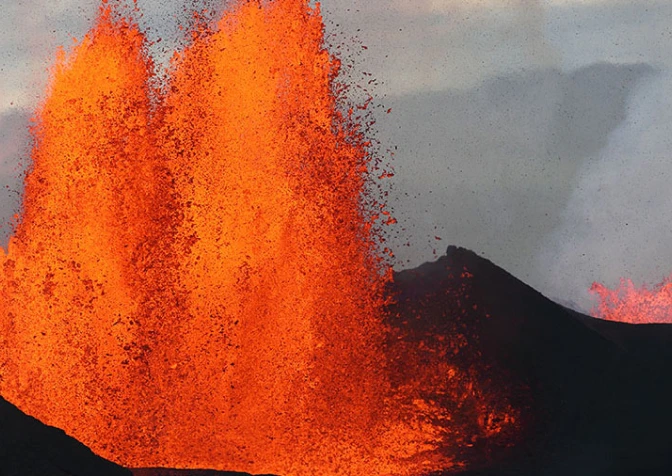
Natural hazards, such as earthquakes, floods and wildfires, rarely occur in isolation. We investigate how they interact with environmental processes and generate cascading and compound risks, which can trigger severe chemical, technological, and environmental crises. To address this complex challenge, we combine cross-disciplinary expertise in atmospheric science, water quality, geochemistry, pollution, and environmental modelling within a coupled socio-environmental framework.
Our research is centered into these four pillars:
Integrated multi-hazard and multi-risk frameworks. We develop methodologies for multi-hazard assessment, management, governance, and resilience under global change.
Cascading hazard interactions and environmental impacts. We investigate the complex interactions between geological, hydrometeorological, environmental, and pollution-related hazards.
Exposure, vulnerability, and predictive systems. We evaluate the exposure, vulnerability, and resilience of ecosystems, infrastructures, and human populations by developing Decision Support Systems, AI-assisted predictive analytics, scenario analysis, and early-warning systems.
Adaptive governance and interdisciplinary integration. We co-develop risk governance strategies and operational tools alongside stakeholders and policymakers, fostering cross-disciplinary collaboration within IDAEA to advance holistic multi-risk assessment and resilience frameworks.
Coordinators

Joan Martí Molist
Juan José Hidalgo González
Key Research Projects

Our publications
Latest scientific contributions
From Multi-Hazard Prevention to Sustainable Emergency Management: A Reproducible Evidence-Mining Framework for Identifying Compounding Risk Patterns
Sustainability — 2026 — DOI: 10.3390/su18168200
Integrated wildfire susceptibility and hazard mapping: A data-driven approach for Mediterranean regions using the Garrotxa (Catalonia, Spain) as a case study
Climate Services — 2026 — DOI: 10.1016/j.cliser.2026.100690
Creation and analysis of a multi-hazard dataset: Tenerife (Canary Islands) as a case study
Earth System Science Data — 2026 — DOI: 10.5194/essd-18-2979-2026
Geological and volcanological constraints on a long-lived and multi-stage collapse caldera: The Caviahue caldera, southern volcanic zone of the Andes
Journal of South American Earth Sciences — 2026 — DOI: 10.1016/j.jsames.2025.105922
Effect of Flow Dynamics on Two‐Phase Flow Patterns in Porous Media
Water Resources Research — 2026 — DOI: 10.1029/2026WR043812
