IDAEA attracts top-tier scientific talent with researcher Tanguy Le Borgne through the ATRAE program
The Institute of Environmental Assessment and Water Research (IDAEA-CSIC) strengthens its research of excellence with the appointment of the prestigious physicist and hydrogeologist Tanguy Le Borgne, under the framework of the ATRAE call from the Ministry of Science, Innovation and Universities. Funded with €800,000, Le Borgne’s project will investigate how three-dimensional porous media flow regulates the dispersion and distribution of subsurface microorganisms, which holds major significance for engineering, environmental, and public health processes.
Tanguy Le Borgne joins IDAEA’s ‘Surface and Groundwater Dynamics’ Research Line and will carry out his project at the Porous Media Multiscale Modeling Laboratory (PM3Lab). Internationally recognized for his contributions to the physics of transport and mixing in complex environments, Le Borgne was awarded the 2020 InterPore Medal for Porous Media Research, one of the most prestigious distinctions worldwide in the study of porous media.
Microbial dynamics in 3D flows
Microorganisms present in soil and the subsurface are essential for the biosphere, public health, and environmental management, yet their behavior remains largely unknown. Although advances in 2D microfluidics have highlighted the importance of fluid flow and chemical gradients in microbial dynamics, Le Borgne’s new project goes a step further by tackling the three-dimensional complexity of these environments.
Recent research led by the scientist has demonstrated that 3D flow in porous media generates chaotic advection, a phenomenon of repeated stretching and folding of fluid elements that produces fine-scale dynamic chemical gradients, radically different from those observed in two dimensions. The project will investigate how this three-dimensional structure regulates bacterial dispersion, mixing, adhesion, and navigation, coupling these dynamics with reactive transport processes.
As a result, the initiative will develop an open-source modeling platform and new quantitative scaling frameworks with direct applications in geoenergy, groundwater resource protection, and environmental remediation.
Meeting with the Prime Minister and the Spanish scientific system
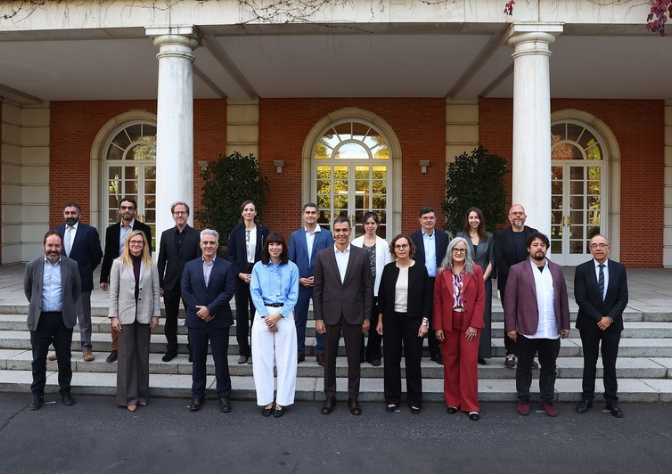
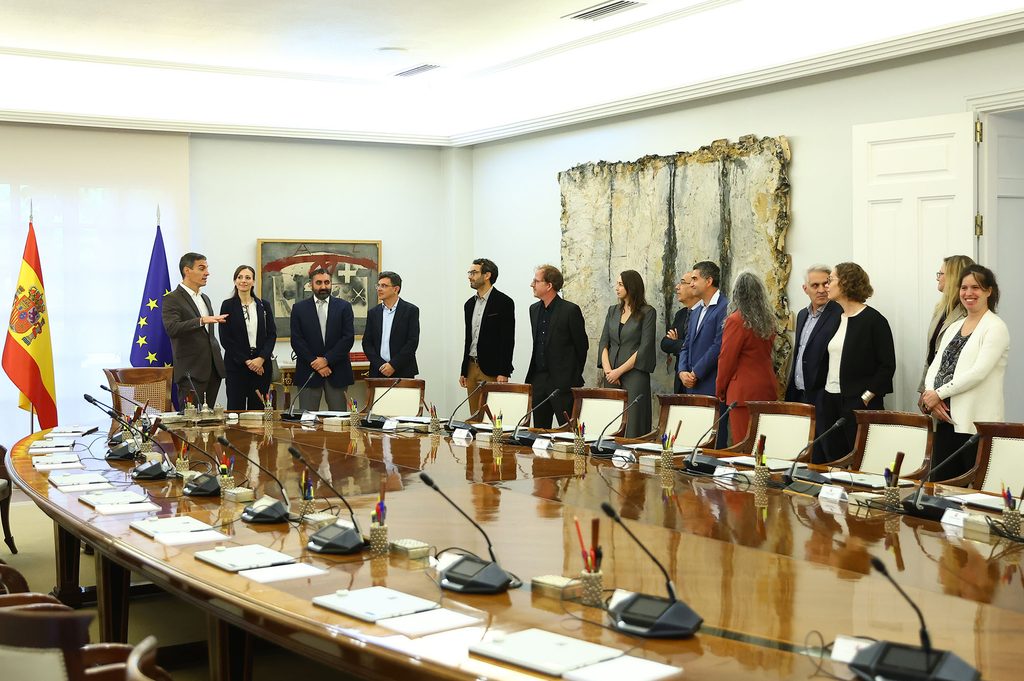
Yesterday, Tanguy Le Borgne attended an institutional meeting between researchers benefiting from the ATRAE call, Prime Minister Pedro Sánchez, and the Minister of Science, Innovation and Universities, Diana Morant.
During the meeting, which focused on Spain’s role as a hub for attracting international scientific talent, Le Borgne highlighted the reasons for his move to the country: “Spain is a country that pushes strongly for science and resists the major political shifts currently taking place,” he stated after the meeting with the Prime Minister.
About the ATRAE program
Promoted by the Ministry of Science, Innovation and Universities and managed by the State Research Agency (AEI), the ATRAE program facilitates the recruitment of internationally recognized top-tier researchers into the Spanish R&D&I system.
With the arrival of Tanguy Le Borgne, IDAEA-CSIC consolidates its capacity to attract top-tier talent and adds a second researcher funded by this highly competitive program. In the 2024 call, the institute had already incorporated researcher Ran Holtzman, reinforcing IDAEA’s leadership as an international reference center in cutting-edge hydrogeology research.