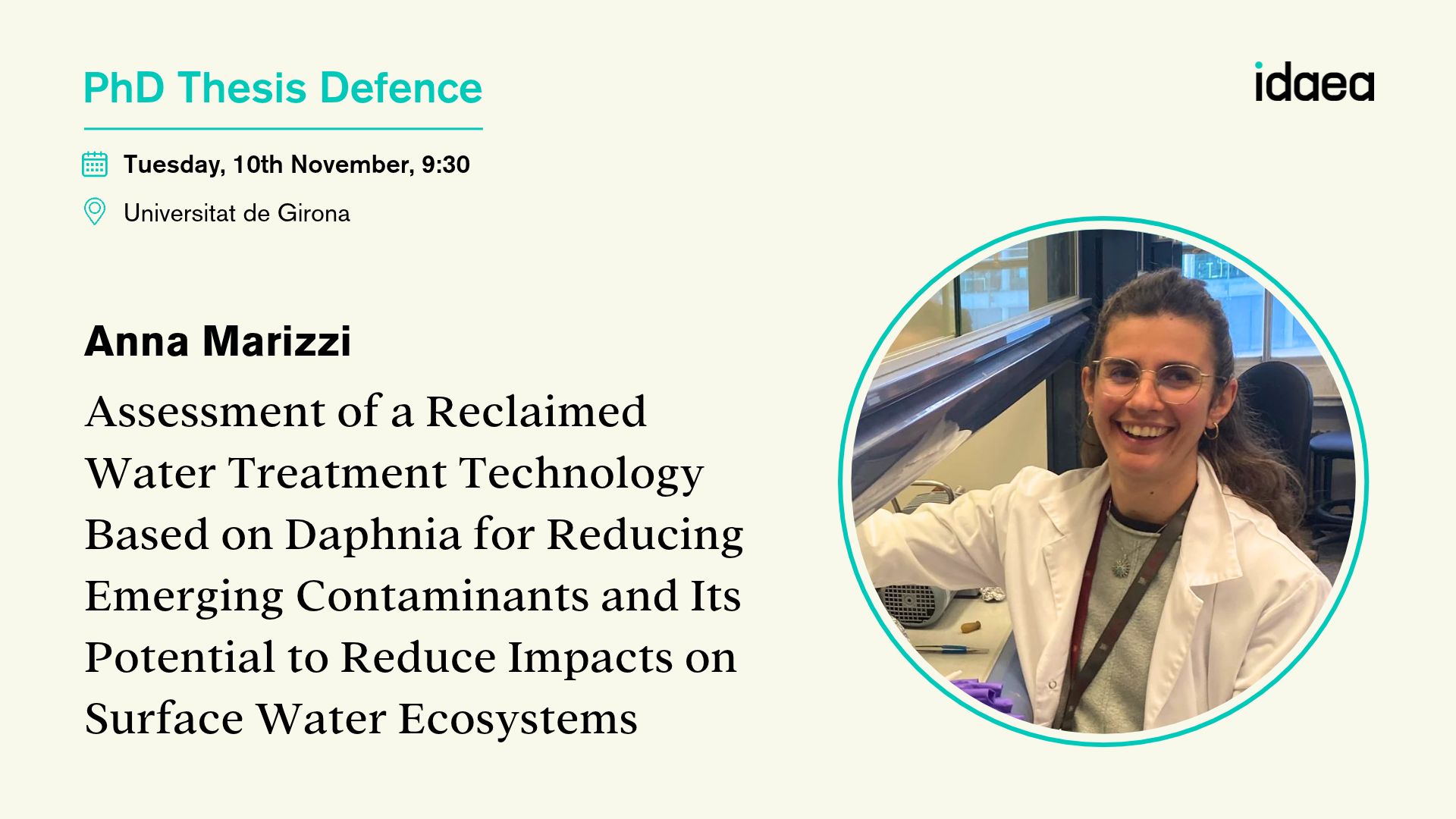

PhD Thesis Defence by Anna Marizzi
The predoctoral researcher Anna Marizzi will defend her thesis on 10th November at 9:30h at the Universitat de Girona.
Title: Assessment of a Reclaimed Water Treatment Technology Based on Daphnia for Reducing Emerging Contaminants and Its Potential to Reduce Impacts on Surface Water Ecosystems
Directors: Víctor Matamoros, Jessica Subirats and Mònica Escolà.
Thesis Committee: Jose Luis Balcázar, Darja Istenic and Claudia Fontas
Abstract:
The availability of freshwater is being compromised by more frequent droughts, heatwaves and intense water demands in the Mediterranean region. In this context, wastewater treatment plant (WWTP) effluents contribute to the maintenance of river flow but also introduce emerging contaminants (ECs) into the water, including microplastics, microcontaminants such as pharmaceuticals, antibiotic resistance genes (ARGs), and altered microbial communities. These ECs can adversely affect aquatic ecosystems, particularly river biofilms, which play an essential role in biogeochemical cycles of rivers. To reduce the impact of secondary wastewater in rivers and following the recent EU Directive 2024/3019, the development and implementation of quaternary wastewater treatment technologies are necessary. Among these technologies are Daphnia-based systems, a nature-based solution (NBS) that utilizes the natural grazing capacity of Daphnia magna and the degradation capacity of biofilm to reduce ECs from wastewater. However, research on the potential of this NBS to reduce ECs (in particular microcontaminants, ARGs and microbial communities) has mostly been limited to laboratory and pilot-scale studies.
To assess this knowledge gap, this PhD firstly studied the effects of discharging a WWTP effluent into a wastewater-dominated river. A variety of ECs were characterised in the WWTP effluent, followed by monitoring these contaminants up to 2.8 km downstream and assessing river biofilm changes (microbial community composition and ARG abundance). Secondly, the PhD studied the capacity of a Daphnia-based system to treat secondary wastewater treatment at demonstration scale (160 m3 working volume). To do so, the removal efficiency of microcontaminants and ARGs, as well as microbial community shifts were evaluated. Lastly, the effects of secondary wastewater and reclaimed water (produced by the aforementioned NBS) were studied using artificial flumes on river biofilm microbial communities and ARG abundance. In addition, microcontaminant degradation kinetics of each wastewater type was assessed.
Overall, this thesis provides holistic information on the effects of WWTP effluents on wastewater-dominated rivers. In addition, by conducting the first demonstration-scale study it significantly expanded the knowledge on Daphnia-based systems, allowing to point out its realistic strengths and limitations. Finally, this thesis gives insights into the potential benefits of discharging reclaimed water on river biofilm.