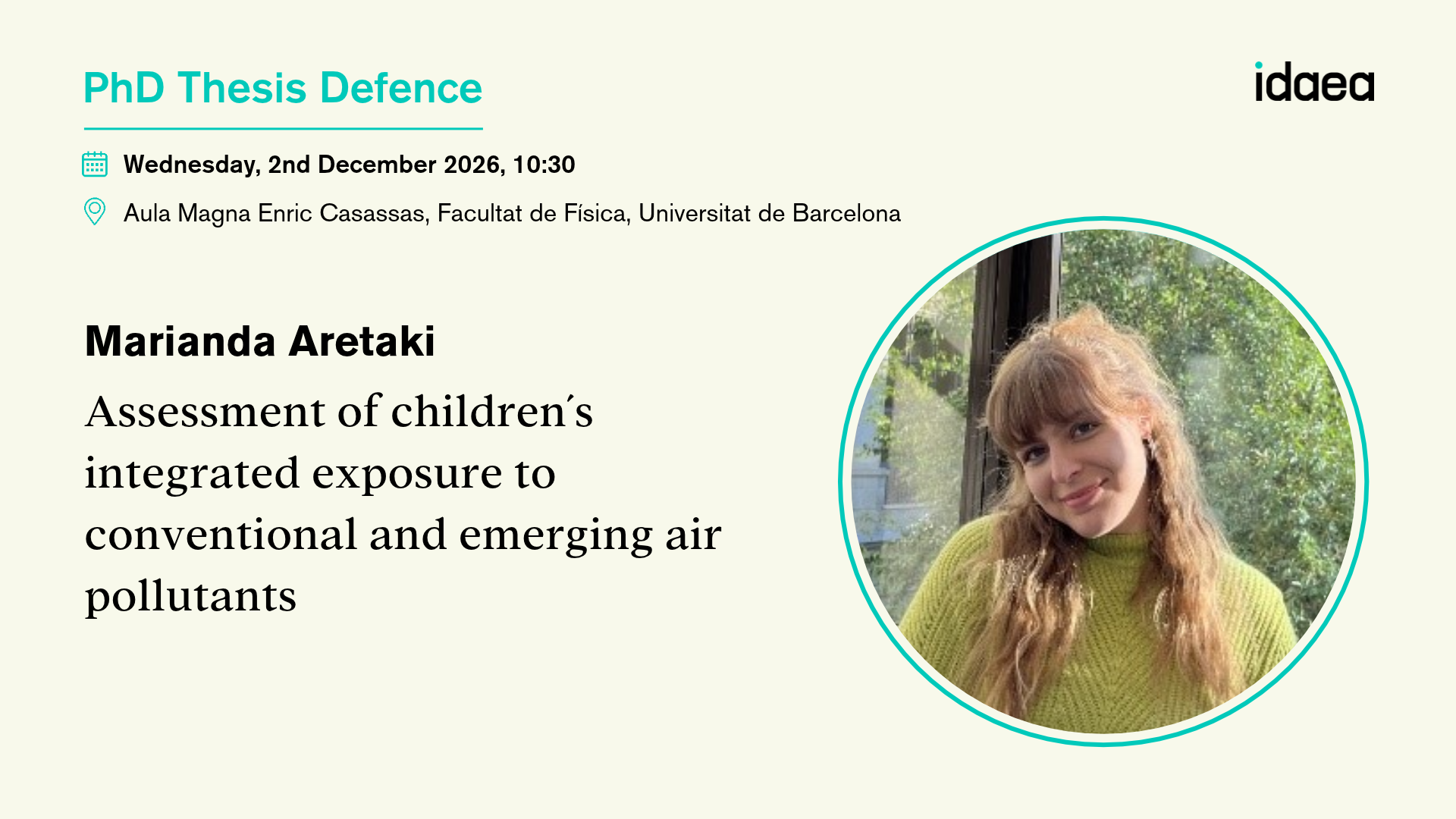

PhD Thesis Defence by Marianda Aretaki
The predoctoral researcher Marianda Aretaki will defend her thesis on 2nd December at 10:30h in Aula Magna Enric Casassas (Facultat de Física, Universitat de Barcelona).
Title: Assessment of children´s integrated exposure to conventional and emerging air pollutants
Directors: Barend L. van Drooge and Mar Viana
Thesis Committee: Michail Lazaridis, Ioar Rivas and Joel Sanchez Piñero
Abstract:
Children are particularly vulnerable to air pollution exposure owing to their developing respiratory and cardiovascular systems. Given the considerable time they spend indoors, indoor air quality (IAQ) is a key determinant of their exposure. Polycyclic aromatic hydrocarbons (PAHs) and black carbon (BC), both originating from incomplete combustion processes, pose significant health concerns. However, obtaining comparable data on children’s exposure to airborne pollutants through field monitoring campaigns remains challenging due to logistical constraints and the complexity of indoor environments.
This doctoral Thesis aims to assess IAQ and children’s exposure to airborne pollutants in homes and schools across six European cities (Athens, Barcelona, Colchester, Copenhagen, Helsinki, and Lisbon) during sampling campaigns conducted between 2023 and 2025. To this end, a simplified active air-sampling and analytical methodology is developed and validated for the simultaneous determination of PAHs in the gas and particulate phases while enabling the multi-compound analysis of other semi-volatile organic compounds (SVOCs). Organic molecular tracers and source apportionment analysis (MCR-ALS) are used to identify the main sources of the indoor organic aerosol in a Barcelona case study, and the association between BC and PAHs is investigated. Furthermore, the potential of passive settled dust sampling as a representative or complementary approach to active air sampling for estimating airborne PAH concentrations is evaluated. The inhalation doses of PAH mixtures, expressed as benzo[a]pyrene equivalents (BaPeq), and the associated excess cancer risk during primary school period (ECR5) are also estimated for the different microenvironments.
Results indicate significant spatial variability in indoor PAH concentrations across the cities with residential biomass burning and traffic emissions identified as the main sources. Colchester exhibited the highest median total PAH concentrations (>60 ng/m³), whereas Barcelona and Lisbon showed the lowest (<12 ng/m³). Comparisons between homes and schools within cities reveal distinct source profiles and microenvironmental characteristics, with ventilation frequency identified as the most relevant factor affecting indoor PAH concentrations. Despite, ECR5 remaining below the USEPA upper acceptable risk limit (10-4), annual mean benzo[a]pyrene concentrations exceeded the WHO guideline of 0.12 ng/m³ at specific sampling sites. Overall, this Thesis provides new evidence that support mitigation strategies for improving IAQ and protecting children’s health.