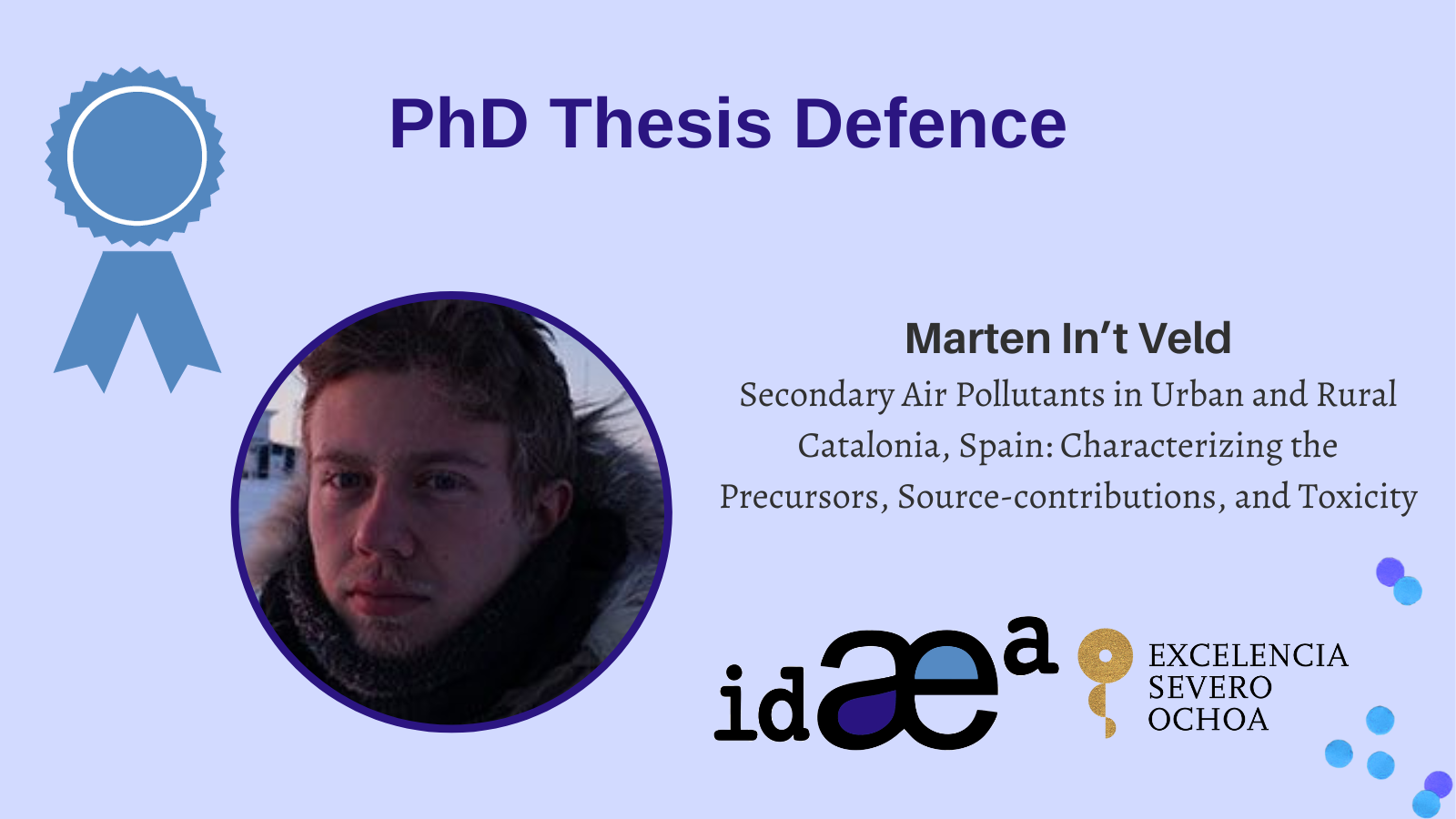

PhD Thesis Defence by Marten In’t Veld
The PhD student Marten In’t Veld, from the EGAR group, will defend his thesis on 29th November at 12:00h in Escola de Camins UPC (Classroom 002, Building C1)
Title: Secondary Air Pollutants in Urban and Rural Catalonia, Spain: Characterizing the Precursors, Source-contributions, and Toxicity.
Directors: Xavier Querol and Nicolas Marchand
Thesis Committee: Jesús Damian de la Rosa, Amalia Muñoz and Maria Piñeiro
Abstract:
Air pollutants can be classed as either primary or secondary pollutants. Primary air pollutants are those that are directly emitted into the atmosphere, whereas secondary air pollutants are generated in the atmosphere from chemical reactions of precursors. This thesis focusses on two specific secondary air pollutants, secondary organic aerosols (SOA) and tropospheric ozone (O3). SOA is formed in the troposphere by the oxidation of precursor volatile organic compounds (VOCs), which are a group of over 1.000 species with high vapor pressure and limited water solubility, emitted from a variety of sources. SOA contributes considerably to atmospheric particulate matter (PM). O3 on the other hand is formed in the troposphere by photolysis of nitrogen dioxide (NO2). NO2 is primarily emitted from anthropogenic activities but is also formed in the atmosphere by the oxidation of nitrogen oxide (NO) by hydroperoxyl and organic radicals (HO2 ?and RO2?, respectively). Both radicals are formed in the atmosphere during the oxidation of VOCs by hydroxyl radicals (OH?). The formed NO2 will consequently photolyze to NO, producing an activated oxygen (O?), which in turn will react with oxygen (O2) to form O3. The aim of this thesis was to identify and quantify SOA’s contributions to PM, as well as to examine temporal trends for both SOA levels and relative contributions to PM. In addition, measurements and a source apportionment were performed on VOCs mixing ratios as these are essential precursors to both SOA and O3 formation. Finally, the levels and major variables of the oxidative potential (OP) of PM (with a emphasis on SOA) were determined to ascertain the impact each variable has on human health. All these studies were carried out at an urban background site in Barcelona (BCN) (Catalonia, NE Spain) and a rural background station at the nearby Montseny natural park (MSY). The comparison of the two sites will reveal which sources are more local and which are more regional, and how BCN emissions can affect regional air quality.
The results indicated that the relative OA mass contribution to PM2.5 has increased with 12% in BCN and 9% in MSY between 2009 and 2018, becoming the dominant component of PM. The offline Aerosol Mass Spectrometer (AMS) identified five common sources of the OA fraction, of which 51% was SOA in BCN and 53% in MSY. However, the composition of SOA differed between the two stations, with summer oxygenated OA (SOOA, being primarily biogenic SOA) being the main driver of SOA in MSY (46% of total OA), while in BCN the contribution of SOOA and winter oxygenated OA (WOOA, being anthropogenic SOA) was roughly equal in BCN (24% and 27% respectively), favoring SOOA during the summer and WOOA in the winter. The OP analysis showed a significant difference between the two stations, with 2.42 nmol DTT min-1 m-3 in PM10 at BCN, compared to 0.52 nmol DTT min-1 m-3 at MSY. The OP levels of PM10, PM2.5, and PM1 were similar in MSY, but in BCN only PM2.5 and PM1 were similar, with the levels of PM10 being substantially higher. The OP analysis concluded that the OA and the non-exhaust vehicle emissions were major drivers of the OP of PM in BCN, which indicated that anthropogenic SOA has a higher OP compared to biogenic SOA. The anthropogenic SOA was mostly formed from aromatic VOCs, especially toluene and C8 aromatics (xylenes and ethyl benzene), which in the study area generally have a major anthropogenic origin, specifically traffic & industries. Aromatic VOCs were also the main contributors to the O3 formation potential in BCN, with also a relevant summer contribution from biogenic VOCs (BVOCs) and a yearlong contribution from oxygenated VOCs (OVOCs)
generated from the oxidation of primary VOCs. MSY on the other hand, showed a less worrying case, with a lower SOA and O3 formation potential compared to BCN.