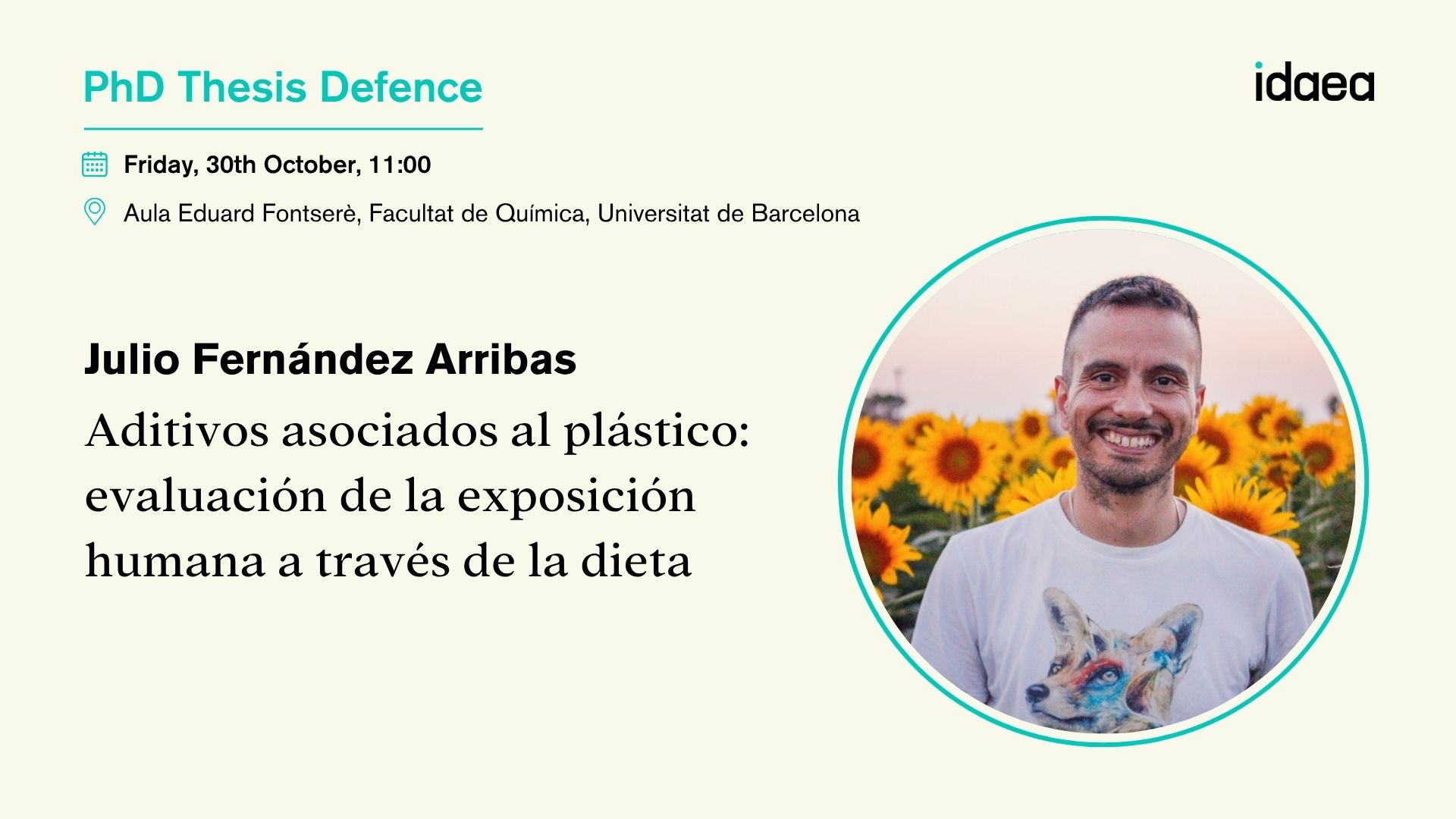

PhD Thesis Defence by Julio Fernández Arribas
The predoctoral researcher Julio Fernández Arribas will defend his thesis on 30th October at 11:00h in Aula Eduard Fontserè (Facultat de Química, Universitat de Barcelona).
Title: Aditivos asociados al plástico: evaluación de la exposición humana a través de la dieta.
Directors: Ethel Eljarrat and Teresa Moreno.
Abstract:
Plastic composition is based on a complex mixture of chemical additives intended to confer specific properties to the polymeric matrix, many of which are readily released into the environment throughout their life cycle. Among these compounds, functional additives such as plasticizers and flame retardants stand out due to their substantial contribution to the final composition of plastic products. In addition, trace elements such as antimony (Sb), lead (Pb), cadmium (Cd), and nickel (Ni) are used in the plastics industry as flame retardants, catalysts, pigments, or thermal stabilizers. This doctoral thesis evaluates the dietary intake of different types of plastic-associated contaminants, particularly phthalates (PAEs), non-phthalate plasticizers (NPPs), organophosphate esters (OPEs), and trace elements, for which evidence indicates that diet is the predominant route of human exposure.
With this purpose, levels of these additives were analyzed in foods, drinking water, and other packaged beverages frequently consumed in Spain. Specifically, method development was performed to determine organic additives, based on online purification by turbulent flow chromatography (TFC), followed by liquid chromatography coupled to tandem mass spectrometry (LC-MS/MS).
The results obtained expand the limited information currently available on the occurrence of OPEs in drinking water. Tap water from urban environments showed significantly higher levels than those found in rural areas and bottled water. Furthermore, children exhibited estimated daily intakes (EDIs) of OPEs through water consumption that were between 2 and 14 times higher than those of adults. In other foodstuffs, di(2-ethylhexyl) adipate (DEHA), acetyl tributyl citrate (ATBC), and 2-ethylhexyl diphenyl phosphate (EHDPP) plasticizers were detected at elevated concentrations in meat, cereals and infant foods, and sugar-sweetened beverages, respectively. Their presence was mainly associated with plastic packaging and coatings, as well as certain food ingredients. Diet was identified as the primary route of exposure to OPEs (78%), surpassing both inhalation and dermal contact. In addition, potential health risks associated with plasticizers were observed in infants and toddlers. Cooking food in plastic containers enhanced additive migration by up to 100-fold, particularly for Sb, whose exposure was of greater concern in children. These findings highlight the need for mitigation measures and continuous monitoring.