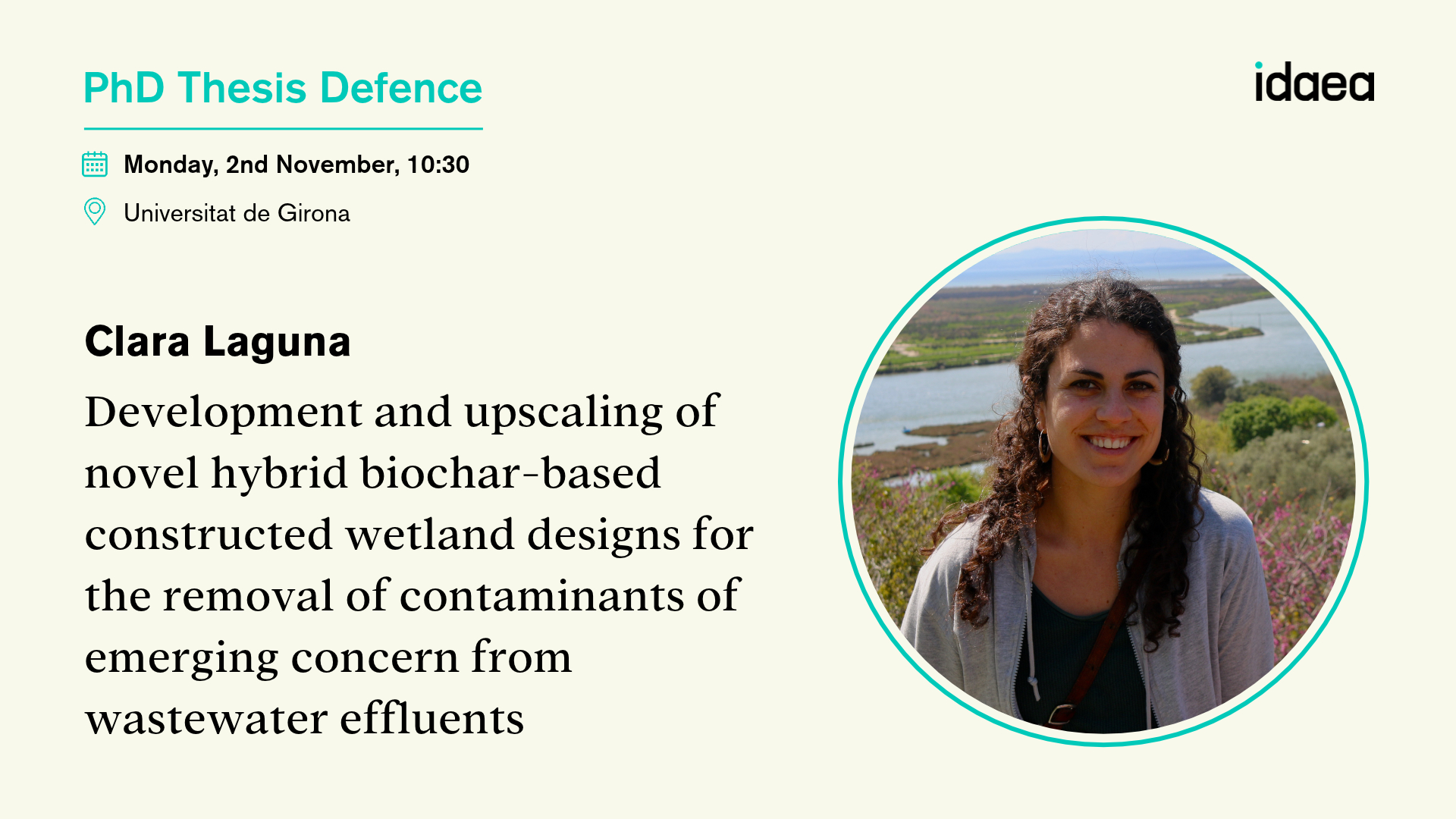

PhD Thesis Defence by Clara Laguna
The predoctoral researcher Clara Laguna will defend her thesis on 2nd November at 10:30h at the Universitat de Girona.
Title: Development and upscaling of novel hybrid biochar-based constructed wetland designs for the removal of contaminants of emerging concern from wastewater effluents.
Directors: Víctor Matamoros, Jessica Subirats and Mònica Escolà.
Thesis Committee: Eugènia Martí, Shubiao Wu and Jaume Puigagut
Abstract:
Constructed wetlands (CWs) have emerged as promising nature-based solutions for quaternary wastewater treatment. These systems can effectively remove nutrients and contaminants of emerging concern (CECs) from wastewater, in line with the new Urban Wastewater Treatment Directive (2024/3019). However, CWs present some limitations, such as large area requirements, that still condition their full-scale application. This has motivated, in recent years, the exploration of different intensification strategies to increase CW performance and applicability.
Within this context, this thesis developed, optimized and evaluated the performance of novel biochar-based intensified CW designs for the removal of nutrients and CECs from wastewater treatment plant (WWTP) effluents. These designs incorporate biochar -a porous carbonaceous product of organic waste pyrolysis- as a reactive material with physicochemical properties that benefit pollutant removal, and explore its integration in hybrid CW systems that combine floating root mats and subsurface horizontal-flow CWs.
The thesis was developed with a sequential approach that went from lab-scale experiments to the development of a pilot-plant in Montcada i Reixac wastewater treatment plant. Lab-scale experiments demonstrated that biochar-based hybrid CWs were able to sustain almost complete CEC removal across different hydraulic loading rates, with minor formation of transformation products. Pilot-scale experiments tested various biochar-based CWs under HLRs from 200 to 800 mm·day-1, in summer and winter, demonstrating notable CEC removal efficiencies. Pilot results also revealed that CEC removal within biochar-based systems was attributed mainly to degradation rather than to pure adsorption. Microbial analyses of the rhizosphere communities in biochar-based wetlands showed enrichment in bacteria associated with nitrogen and xenobiotic transformations, supporting the existence of biodegradation processes. Pilot-scale systems were also capable of removing wastewater-associated bacteria, reducing the microbiological impact of WWTPs. Furthermore, the economic assessment highlighted the cost-effectiveness of the developed configurations, with a 30-year life-cycle cost of €0.04-0.05·m-3, lower than that of advanced oxidation processes.
The findings of this thesis support the potential of biochar-based CWs as an effective, robust, and economically viable solution for advanced wastewater treatment, and provide valuable insights into the upscaling of CW systems